

Your company is probably spending a lot of money on your learning and development. But are you really developing, or just learning?
More...
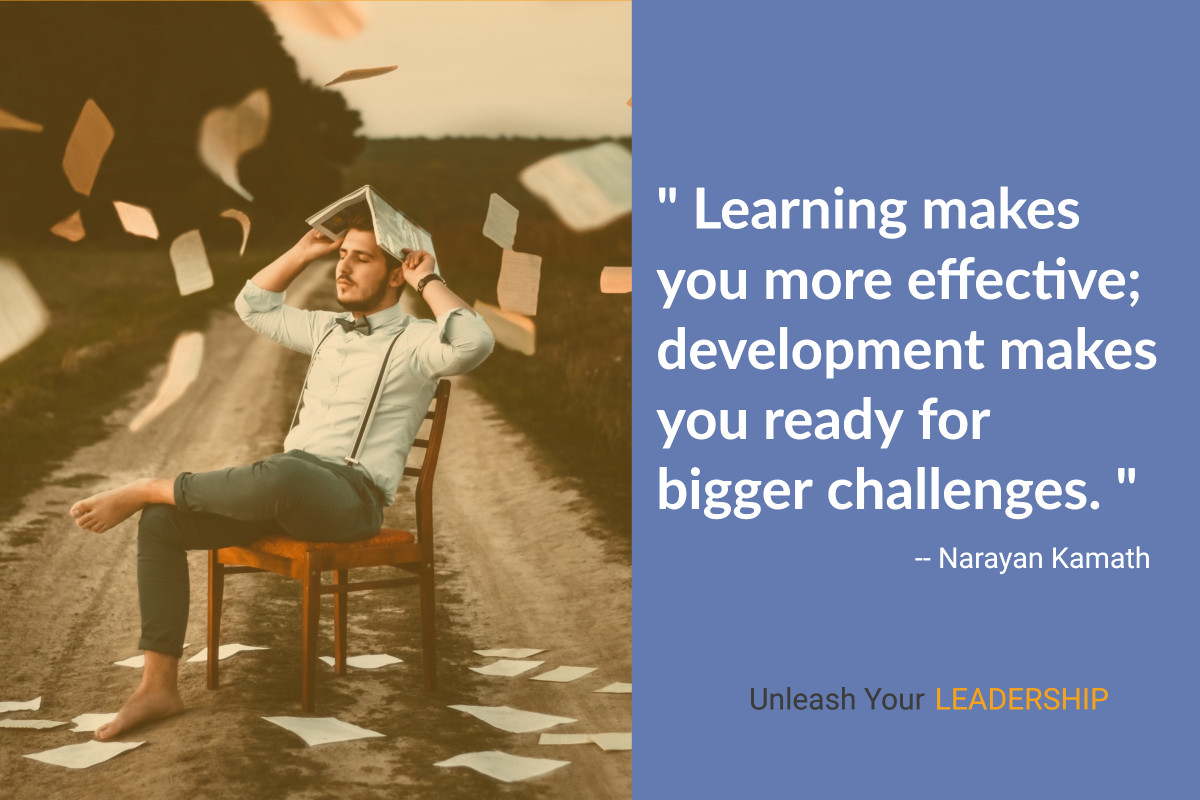
If you are like most leaders I work with, you probably have an intuitive understanding of the difference between learning and development. When a client asked me the distinction between two, I said : "Learning makes you more effective in your current job, while development prepares you for the next/bigger role."
In hindsight, while this is pithy, in terms of intended outcomes, it is interesting to see how these are fundamentally different and require different approaches. One useful way of understanding the differences is Gianpiero Petriglieri's distinction between Incremental and Transformative learning.
Learning makes you more effective in your current role; Development prepares you for bigger challenges
Incremental Learning vs Transformational Learning
Incremental learning involves acquisition or enhancement of knowledge and skills, and reinforces our identities and commitments. Transformative learning on other hand is about new ways of seeing, sense-making and relating. It brings about an evolution in our identities, and the meanings of our commitments. In other words, transformative learning leads to development.
The two types of learning are distinct, not only in their impact, but also in how they come about. Incremental learning requires intense focus, deliberate practice, and immediate feedback. It happens best within the working environment, or a close replica of the same
Transformative learning, on the other hand, happens best away from the work environment, and involves a softer (diffused) focus, reflective engagement and playful experimentation. Dialogue that supports and deepens reflection facilitates transformative learning.
Why leaders do not prioritise development
Most leaders are comfortable with incremental learning. The fact that it happens on the job is reassuring - it feels like work. The impact is also easier to see and measure - it shows up in our effectiveness and competence. This also extends to our output - we produce better, cheaper, faster.
While leaders see value in transformative learning, they are less comfortable embracing it. Since it requires stepping away from work, it feels like - slacking. And while it is possible to see the value of expanded perspectives and more nuanced understanding, it is harder to measure and provide concrete evidence in terms of short-term output.
The impact of development is difficult to demonstrate, but easy to experience
The impact of development may be difficult for you to demonstrate but is easy for people around you to experience. You will come across as more strategic, more innovative, more mature, wiser, and inspirational; in other words, ready for a bigger challenge.
What steps are you taking to make more space for transformative learning in your work?
Image source : Dmitry Ratushni via Unsplash
